| Category | Institutional |
|---|---|
| Year | 2011 |
| Size | 68,000sqm |
Projects
CREATE @ NUS UTown
Configuring CREATE
Officially opened in 2012, the Campus for Research Excellence and Technology (CREATE) is envisioned as a world-class research facility. Co-located with NUS University Town and within the vicinity of other high-tech centres in Singapore such as Biopolis and Fusionopolis, its geographical point reflects its contextual purpose. And it does not stop there. A project that DP Architects undertook in collaboration with Perkins+Wills of USA, its design schematics also cleverly plays into its site context and embraces the vision for CREATE. Working closely with the architectural team to configure the 16-storey tower and its three East bar blocks, our desire was for the building to speak of the kind of research excellence and technological innovation that CREATE would be renowned for.
Details
The highly sustainable design of this building can be read directly on its building envelope.
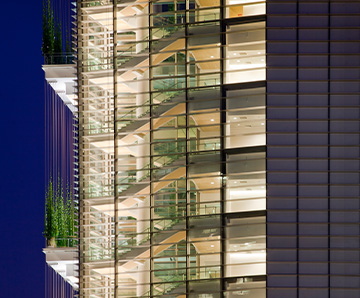
Made of specially-designed thin steel frames with fire-rated glass, the tall glass wall at the lower floors complies with local life safety regulations.
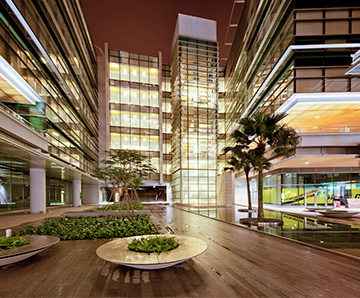
Beyond functionality, the glass wall façade enables the campus to transform into a uniquely lit space that at once stands out and melds into its immediate urban fabric.
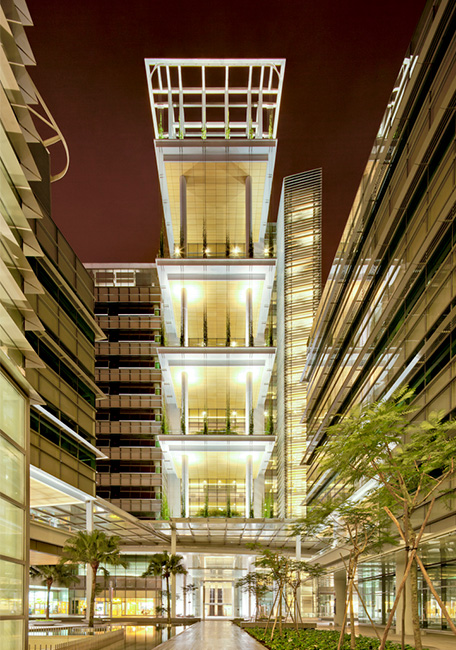
Featuring triple-storey sky terraces with bespoke green walls, the façade design allows the building and its architecture to relate back to the natural surroundings.
It’s all in the system
Simple but sophisticated, at a glance, the architectural aesthetics of CREATE appear to simply meld the building with its academic context. A closer look, however, unveils design excellence that is realised through its host of façade systems. One testament to this is the pioneering use of environmental sustainability and energy efficient technologies such as photovoltaic or BIPV panels on the building façade. Complementing the glazed curtain wall, it effectively offsets part of the electricity consumption of the building.
Beyond this, its design schematics are also careful to minimise building footprints through the preservation of open spaces for a managed and naturalised landscape. Our façade design supports this by incorporating massive glazed skylight to shelter passers-by from weather elements of the tropics. It also features triple-storey sky terraces with bespoke green walls. This essentially allows the building and its architecture to relate back to the natural surroundings.
Specialist Services
Integrated services provided for this project.
AWARDS
| 2013 |
BCA Construction Excellence Award CREATE project |
|---|